
Income to Buy a House in Toronto, Mississauga and Oakville (by Home Type)
How much income you need to buy each type of home in Toronto, Mississauga and Oakville, how the stress test works, and a free calculator.
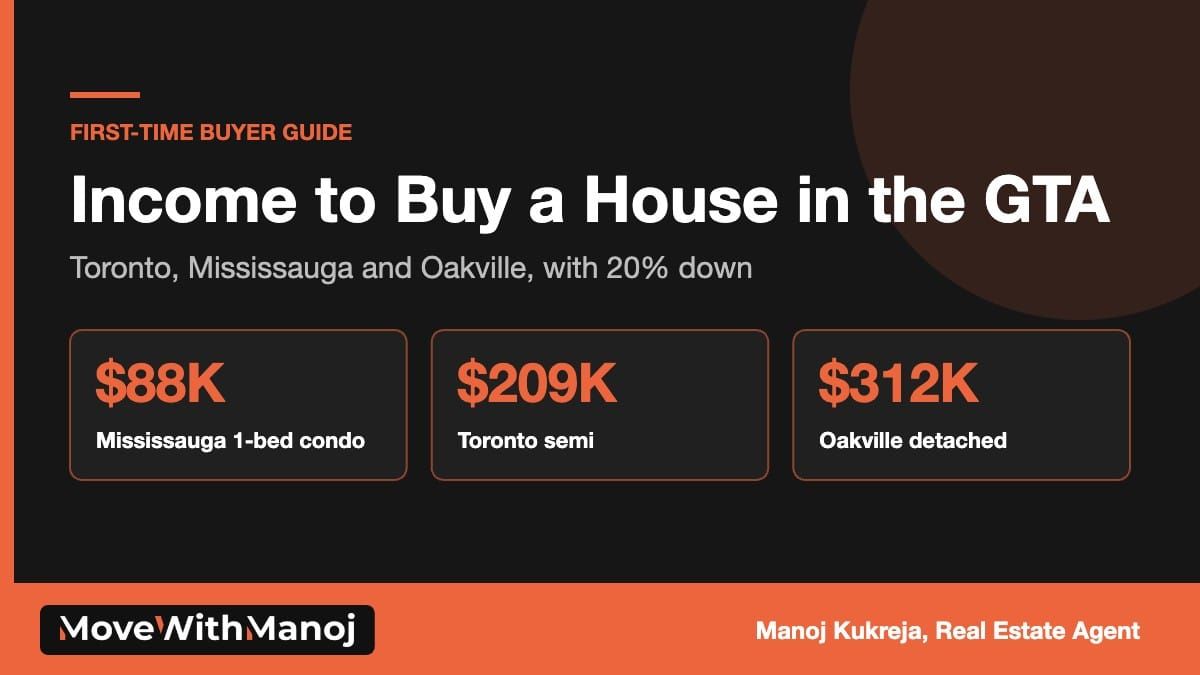

Almost every first conversation I have with a buyer starts the same way: "Manoj, can we actually afford this?" It's the right question to start with. Before you fall in love with a backyard in Oakville or a condo near Square One, it helps to know roughly what income a lender will want to see for the kind of home you have in mind.
Before real estate I spent a decade at major Canadian banks, and worked as a financial planner, so I've looked at this from both sides of the desk. Below I'll walk you through how lenders work out what you can borrow, the income you'd need for each type of home in Toronto, Mississauga and Oakville, and a simple calculator you can play with yourself.
Want today's prices first? See Toronto, Mississauga and Oakville house prices by home type, updated every month.
In this guide
The short answer
If you put 20% down, here's the household income you'd need, roughly, for a typical home in each city (based on late-2026 average sold prices, rounded):
| Type of home | Toronto | Mississauga | Oakville |
|---|---|---|---|
| 1-bedroom condo | $96K | $88K | $92K |
| 2-bedroom condo | $145K | $110K | $152K |
| Condo townhouse | $134K | $130K | $131K |
| Semi-detached | $209K | $163K | $154K |
| Freehold townhouse | $211K | $158K | $169K |
| Detached | $270K | $236K | $312K |
The biggest takeaway: with 20% down, a 1-bedroom condo is within reach on a household income of roughly $88,000 to $96,000, and a 2-bedroom condo or condo townhouse on about $110,000 to $152,000, while a detached house needs about $235,000 in Mississauga and $270,000 to $310,000 in Toronto and Oakville. Most couples I work with land somewhere in between, which is why semis and freehold towns are so popular with move-up and first-time buyers.
How I worked this out: a 20% down payment, so no CMHC mortgage insurance, a 30-year amortization (most lenders offer up to 30 years when you put 20% down; choosing 25 years raises the income needed by about 6%), a 4% five-year fixed rate stress-tested at 6%, the city's 2026 residential property tax rate applied to the price, $150 a month for heating, and condo fees of about $450 (condo townhouse), $550 (1-bedroom) or $700 (2-bedroom) a month. No car loans or other debts. Your numbers will be different, so use the calculator further down.
How lenders decide what you can afford
Banks don't guess. They run your application through three tests, and the strictest one sets your limit.
1. The stress test
Every federally regulated lender has to qualify you at the higher of your contract rate plus 2%, or 5.25%. So if your five-year fixed rate is 4%, the bank checks whether you could handle the payment at 6%. You only pay 4%, but you have to qualify at 6%. This one rule is why many buyers can afford less than they expect.
2. Your debt ratios (GDS and TDS)
Most lenders cap your gross debt service (GDS) ratio at around 39% and your total debt service (TDS) ratio at around 44%, the same limits CMHC sets for insured mortgages. In plain English: your mortgage payment, property tax, heating and half of any condo fee can't be more than 39% of your gross income, and once you add your car loan, credit cards and lines of credit, the total can't go past 44%.
That's why a $600 car payment matters so much. It can knock tens of thousands off what you can borrow.
3. Your down payment
The numbers in this guide assume 20% down. At 20% or more there's no mortgage insurance, so your mortgage is smaller and so is the income you need. You can buy with less: the minimum in Canada is 5% of the first $500,000 and 10% of the portion above that, for homes under $1.5 million. But below 20% you pay a CMHC insurance premium of up to 4%, added to your mortgage. At $1.5 million and above, 20% down is required.
| Price | 20% down | Minimum down |
|---|---|---|
| $500,000 | $100,000 | $25,000 |
| $700,000 | $140,000 | $45,000 |
| $900,000 | $180,000 | $65,000 |
| $1,200,000 | $240,000 | $95,000 |
| $1,600,000 | $320,000 | $320,000 (20% required) |
With 20% down, most lenders let you choose a 30-year amortization instead of 25, which lowers the monthly payment and helps you qualify. You'll pay more interest over time, but for many of my clients it's the difference between getting into the market now or waiting. First-time buyers putting less than 20% down can get 30 years too.
Income you need in Toronto
Toronto is the priciest of the three for semis and freehold townhouses, but it also has the widest choice of condos, which is where most first-time buyers start.
| Type of home | Typical price | 20% down | Monthly mortgage at 4% | Income needed |
|---|---|---|---|---|
| Detached | $1,600,000 | $320,000 | $6,087 | $270,000 |
| Semi-detached | $1,230,000 | $246,000 | $4,679 | $209,000 |
| Freehold townhouse | $1,240,000 | $248,000 | $4,717 | $211,000 |
| Condo townhouse | $740,000 | $148,000 | $2,815 | $134,000 |
| 1-bedroom condo | $500,000 | $100,000 | $1,902 | $96,000 |
| 2-bedroom condo | $780,000 | $156,000 | $2,967 | $145,000 |
Prices move every month, so check the latest Toronto house prices by home type, or browse homes for sale in Toronto.
One Toronto-only cost to plan for: buyers pay land transfer tax twice, once to Ontario and once to the City. On a $1,000,000 home that's about $33,000 before any first-time buyer rebate. My Toronto land transfer tax calculator shows your exact number.
Income you need in Mississauga
Mississauga gives you more space for your money than Toronto in almost every category, and its condo apartments are some of the most affordable in the GTA.
| Type of home | Typical price | 20% down | Monthly mortgage at 4% | Income needed |
|---|---|---|---|---|
| Detached | $1,330,000 | $266,000 | $5,060 | $236,000 |
| Semi-detached | $910,000 | $182,000 | $3,462 | $163,000 |
| Freehold townhouse | $880,000 | $176,000 | $3,348 | $158,000 |
| Condo townhouse | $680,000 | $136,000 | $2,587 | $130,000 |
| 1-bedroom condo | $430,000 | $86,000 | $1,636 | $88,000 |
| 2-bedroom condo | $540,000 | $108,000 | $2,054 | $110,000 |
Prices move every month, so check the latest Mississauga house prices by home type, or browse homes for sale in Mississauga.
Income you need in Oakville
Oakville's detached homes sit at the top of the market, but its semis and townhouses are often closer to Mississauga prices than people expect.
| Type of home | Typical price | 20% down | Monthly mortgage at 4% | Income needed |
|---|---|---|---|---|
| Detached | $1,830,000 | $366,000 | $6,962 | $312,000 |
| Semi-detached | $890,000 | $178,000 | $3,386 | $154,000 |
| Freehold townhouse | $980,000 | $196,000 | $3,728 | $169,000 |
| Condo townhouse | $710,000 | $142,000 | $2,701 | $131,000 |
| 1-bedroom condo | $470,000 | $94,000 | $1,788 | $92,000 |
| 2-bedroom condo | $810,000 | $162,000 | $3,081 | $152,000 |
Prices move every month, so check the latest Oakville house prices by home type, or browse homes for sale in Oakville.
Try the income calculator
Change the price, your down payment, the rate and your monthly debts to see the income a lender would want for your situation. It uses the same rules as above.
Estimate only, not a mortgage approval. Assumes $150/month heating and property tax at the city's 2026 residential rate applied to the price (your actual bill may be lower). Lenders' rules vary.
Ways to buy with less income
- Pay off small debts first. Clearing a car loan or credit card balance before you apply can raise what you qualify for more than a raise at work.
- Choose a 30-year amortization. It lowers the payment the lender tests you on.
- Grow your down payment with an FHSA and the RRSP Home Buyers' Plan. An FHSA lets you put away up to $8,000 a year ($40,000 lifetime) tax-deductible and take it out tax-free for your first home, and the Home Buyers' Plan lets each buyer borrow up to $60,000 from their RRSP. I explain how to stack them in my FHSA guide and first-time buyer tax savings guide.
- Can't reach 20% yet? On homes under $1.5 million you can buy with as little as 5% down. You'll pay CMHC insurance and need a higher income, so run your numbers in the calculator above.
- Consider a home with a legal second unit. Lenders can count rental income from a legal basement apartment toward qualifying.
- Look one step down the ladder. A freehold town instead of a semi, or a semi in Mississauga instead of Oakville, can lower the income you need by $20,000 to $60,000.
Already own a home?
If you're moving up, the equity in your current home is usually your biggest down payment. Find out what your home is worth today, free and with no obligation.
Get my free home evaluation →Frequently asked questions
How much income do I need to buy a house in Toronto?
With 20% down, roughly $96,000 for a 1-bedroom condo, $145,000 for a 2-bedroom condo, about $209,000 for a semi-detached house and around $270,000 for a detached house, based on late-2026 prices. The exact number depends on your rate, debts and down payment.
How much do I need to make to buy a house in Mississauga?
With 20% down, roughly $88,000 for a 1-bedroom condo in Mississauga, $110,000 for a 2-bedroom, about $158,000 to $163,000 for a freehold townhouse or semi, and around $236,000 for a detached house.
What is the mortgage stress test in Canada?
Lenders must qualify you at the higher of your mortgage rate plus 2% or 5.25%. It shows you could still afford your payment if rates went up.
Can two incomes be combined to qualify?
Yes. Lenders look at total household income from everyone on the mortgage, and debts from everyone on the mortgage too.
Does a bigger down payment lower the income I need?
Yes. A bigger down payment means a smaller mortgage, and at 20% or more there's no mortgage insurance premium added on top.
Knowing your number is the first step. When you're ready to see what's out there in your price range, or you want help working through the numbers with your lender, I'm happy to help.
If you own a home now, start by finding out what it's worth. It's free and there's no obligation: get your free home evaluation, or call me at 647-576-2100.