
First-Time Buyers: How Much Money Are You About to Leave on the Table?
Ontario's first-time buyer programs can be worth a few thousand dollars or well over $100,000. What you get depends on your income, savings, timeline and the order you use them. See every option, then get your own free savings plan.
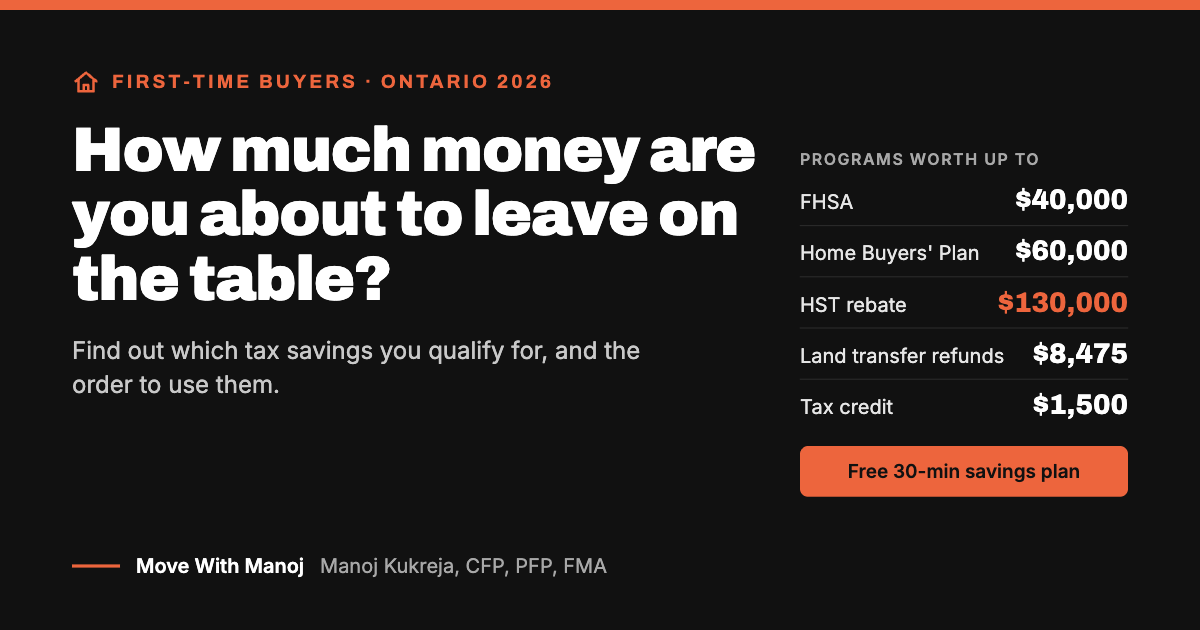
Here's a question most first-time buyers can't answer: how much of the government's help are you actually going to get?
Between the FHSA, the RRSP Home Buyers' Plan, the HST rebate, land transfer tax refunds and tax credits, Ontario's first-time buyer programs can be worth anywhere from a few thousand dollars to well over $100,000. But what you get depends on four things: your income, your savings, your timeline, and the order you use them in.
That's why so many buyers feel stuck. You've read the articles. You've heard the acronyms. But nobody has sat down with your numbers and told you what to do first.
This guide walks you through every option in plain English. Then it helps you spot which scenarios apply to you, so you can see where your biggest savings are likely to be.
Want the short version? We'll look at your finances together, and you'll leave knowing which programs you qualify for, roughly what they're worth to you, and the order to use them.
Book a Free 30-Min Session →Every program at a glance
Here's everything available to first-time buyers in Ontario in 2026:
| Program | What it does for you | Up to |
|---|---|---|
| First Home Savings Account (FHSA) | Tax refund going in, tax-free coming out, never repaid | $40,000 per person |
| RRSP Home Buyers' Plan (HBP) | Borrow from your RRSP tax-free for your down payment | $60,000 per person |
| First-time buyer HST rebate | Full 13% HST back on a new home up to $1M | $130,000 |
| Ontario land transfer tax refund | Cuts the provincial land transfer tax at closing | $4,000 |
| Toronto land transfer tax rebate | Extra rebate if you buy in the City of Toronto | $4,475 |
| Home Buyers' Tax Credit | Federal tax credit on your tax return | $1,500 |
| 30-year insured mortgage | Lower monthly payments with less than 20% down | Homes up to $1.5M |
You can combine most of these on the same purchase. The trick is knowing which ones apply to you and the order to use them in.
Looking at that table and wondering which ones are yours? That's the most common question I hear. The answer is different for every buyer, and it's exactly what we'll work out together. Find out what you qualify for →
Each strategy in plain English
1. First Home Savings Account (FHSA)
The best account a first-time buyer can have. You put in up to $8,000 a year ($40,000 total), get a tax refund on every dollar, and withdraw it all tax-free for your home. You never pay it back.
The catch most people miss: your room only starts the year you open the account. Open it by December 31, 2026, even with $0, and you could put in $16,000 next year instead of $8,000. Read my full FHSA guide.
2. RRSP Home Buyers' Plan (HBP)
If you have RRSP savings, you can take out up to $60,000 tax-free for your down payment. Unlike the FHSA, it's a loan to yourself: you repay it into your RRSP over 15 years.
Watch out: money has to sit in your RRSP for at least 90 days before you withdraw it under the HBP, or you lose the deduction on that contribution.
3. First-time buyer HST rebate (new homes only)
Buying a brand-new or substantially renovated home? First-time buyers can get the full 13% HST back on a new home up to $1 million. On a $750,000 new build, that's up to $97,500. This doesn't apply to resale homes.
4. Land transfer tax refunds
Every buyer in Ontario pays land transfer tax at closing. As a first-time buyer, you get up to $4,000 back on the provincial tax. Buying in the City of Toronto? You pay a second, municipal land transfer tax, and you can get up to $4,475 back on that too. Your lawyer usually claims these for you at closing.
5. Home Buyers' Tax Credit
A $10,000 non-refundable credit on your tax return the year you buy, worth up to $1,500 in tax savings. Simple, but easy to forget.
6. 30-year insured mortgage
This isn't a tax break, but it makes a big difference. First-time buyers with less than 20% down can now get a 30-year amortization on an insured mortgage, and insured mortgages are now available on homes up to $1.5 million. That means lower monthly payments and more homes within reach.
7. Your TFSA
Not a home-buying program, but a powerful backup. Money in a TFSA grows tax-free and comes out tax-free any time, which makes it ideal for closing costs, moving and a safety cushion.
What it can add up to: a real-world example
Meet Priya and Daniel (an illustrative couple). Both are first-time buyers earning around $60,000 each. They buy a $750,000 new townhome in Mississauga. Each opened an FHSA and maxed it out, and each had $30,000 in their RRSP.
| Strategy | What they get |
|---|---|
| FHSA savings toward down payment (2 × $40,000) | $80,000, withdrawn tax-free |
| Tax refunds from FHSA contributions (approx.) | ~$24,000 |
| Home Buyers' Plan (2 × $30,000) | $60,000 for the down payment |
| First-time buyer HST rebate | Up to $97,500 |
| Ontario land transfer tax refund | $4,000 |
| Home Buyers' Tax Credit | $1,500 |
The result: a $140,000 down payment built mostly with tax-advantaged money, and roughly $127,000 in taxes they didn't have to pay.
If they bought a resale home instead, the HST rebate wouldn't apply. They'd still keep about $29,500 in tax savings, plus the same down payment help.
So what's your number?
Priya and Daniel's numbers aren't yours. Your income, your RRSP, whether you're buying solo or with a partner, and whether you'd consider a new build can swing your total by tens of thousands of dollars.
The only way to know is to run your own numbers. That's what the free session is for.
Quick self-check: which of these sound like you?
Take 30 seconds and tick every line that applies to you. Each one changes which strategies make sense, and in what order.
Ticked two or more? Then you may be missing savings, or using programs in an order that costs you money. Every box you ticked is a decision point, and getting each one right is what turns a few thousand dollars in savings into tens of thousands.
This is exactly what we sort out in 30 minutes, using your real numbers.
Book My Free Session & Get My Plan →
6 mistakes that cost first-time buyers money
- ✗Waiting to open an FHSA. Every year you wait is $8,000 of tax-free room you never get back.
- ✗Using the programs in the wrong order. Draining your RRSP before filling your FHSA can mean repaying money you didn't need to borrow.
- ✗Missing the 90-day RRSP rule. A last-minute RRSP deposit before closing can cost you the deduction.
- ✗Claiming deductions in the wrong year. A deduction is worth more when your income is higher.
- ✗Overlooking new construction. Skipping new builds without running the numbers can leave a five- or six-figure HST rebate on the table.
- ✗Shopping before planning. Falling in love with a home before you know your full budget and savings plan leads to rushed, expensive decisions.
Your free First-Time Buyer Savings Plan: what you'll walk away with
This isn't a sales pitch. It's 30 minutes about your money. We'll go through your income, savings and timeline together, and you'll leave with:
| 1 | Your eligibility check. Exactly which programs you qualify for, including the ones you've never heard of. |
| 2 | Your savings estimate. A realistic idea of what these programs could be worth to you in tax refunds, rebates and down payment help. |
| 3 | Your order of operations. Which account to fill first, when to use your RRSP, and when to claim your deductions. |
| 4 | Your December 31 checklist. What to do before year-end so you don't lose a year of FHSA room. |
| 5 | Your buying budget. A clear sense of what you can comfortably afford and how long it will take to get there. |
It's free, there's no obligation, and the plan is yours to keep, whether you buy in six months or five years.
Why work with me
Most agents can help you find a home. I can also help you pay for it smarter.
Before I moved into real estate in 2013, I spent a decade at major Canadian financial institutions. I'm a Certified Financial Planner (CFP), I also hold the PFP and FMA designations, and I've been recognized among Canada's top ten financial planners. Since then, I've helped over 100 families across the GTA buy and sell homes.
That's why I start with your financial plan, not with listings. When you understand your numbers and your options, every decision after that gets easier.
10 years
at Canadian financial institutions
CFP, PFP, FMA
financial planning designations
100+ families
helped across the GTA
Questions people ask before booking
Is it really free?
Yes. No cost and no strings attached.
Do I need to be ready to buy?
No. The earlier we talk, the more you can save. Many of these strategies work best when you start years ahead.
Do I have to use you as my agent?
No. The plan is yours to keep, whatever you decide.
I'm not sure I count as a first-time buyer.
That's one of the first things we'll check. You may qualify even if you've owned a home before, as long as you haven't lived in one you or your partner owned in the past four years or so.
Should my partner join?
Yes, if you're buying together. Many of these programs are per person, so planning together can double what's available to you.
What should I have handy?
A rough idea of your income, your savings (RRSP, TFSA and anything else), and when you'd like to buy. That's it.
Stop guessing. Get your plan.
You don't have to figure this out alone, and you shouldn't have to leave money on the table because the rules are confusing.
In 30 minutes, you'll understand your own finances, see which scenarios apply to you, and know exactly what to do next, starting before December 31.
Book My Free First-Time Buyer Savings Plan →Prefer to talk first? Call or text me at (647) 576-2100.
— Manoj Kukreja, CFP, PFP, FMA
P.S. The FHSA is the one strategy with a hard deadline this year. If you open it by December 31, you could contribute $16,000 next year instead of $8,000 ($32,000 instead of $16,000 as a couple). Even if you're years away from buying, that's worth a 30-minute conversation. Book it here.
This article is general information, not personalized tax, legal or financial advice. The example couple is illustrative; tax refund figures are approximate and depend on your full tax situation. Program rules, limits and eligibility can change. Figures reflect 2026 limits. Manoj Kukreja, Century 21 People's Choice Realty Inc., Brokerage. Not intended to solicit buyers or sellers currently under contract with a brokerage.
Sources