
First Time Home Buyer Ontario (2026): Every Program, Rebate and Tax Break
Every first-time home buyer program in Ontario for 2026, in plain English: the FHSA, the RRSP Home Buyers' Plan, land transfer tax rebates, the home buyers' tax credit and new-home HST rebates.
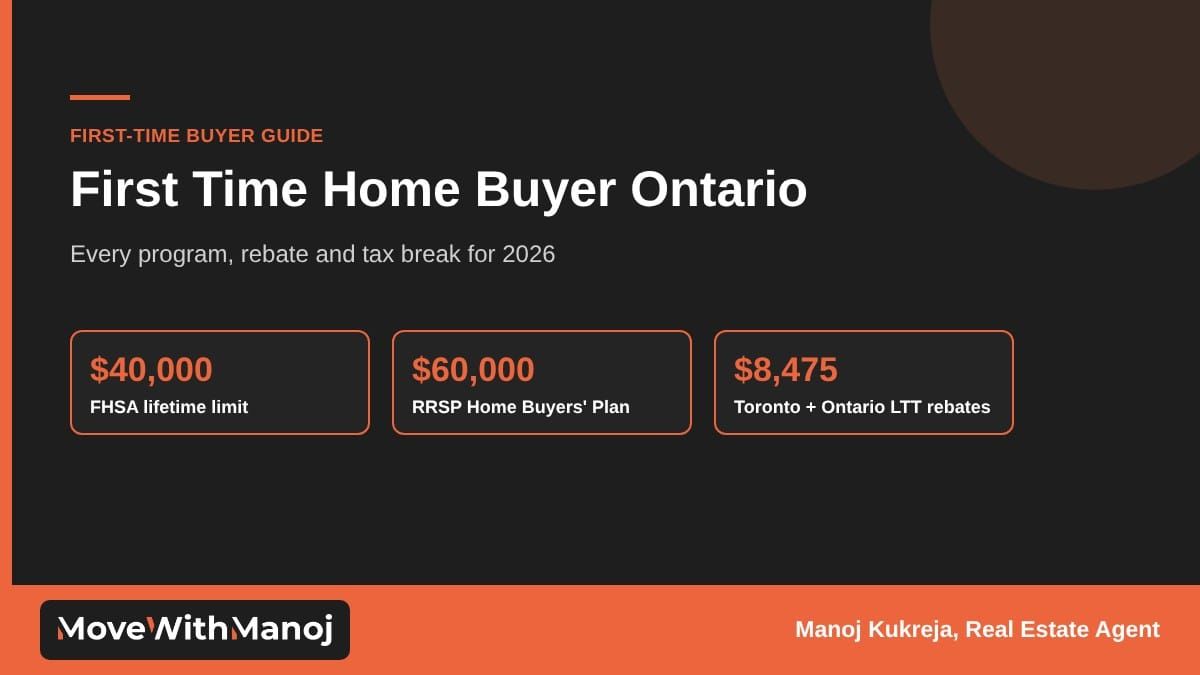

Buying your first home in Ontario is exciting, and it can also feel like a lot of paperwork and acronyms. The good news is that as a first time home buyer in Ontario you have more help available than almost anyone else in the market, and it can add up to tens of thousands of dollars.
Before I became a real estate agent in 2013, I was a Certified Financial Planner, and I still love this part of the job: helping first-time buyers keep more of their money. Below is every program that matters in 2026, explained in plain English, with the official rules checked against government sources.
Want to start looking? See every condo for sale in Toronto or every condo for sale in Mississauga.
In this guide
- All the programs at a glance
- First Home Savings Account (FHSA)
- RRSP Home Buyers' Plan
- Using the FHSA and RRSP together
- How much tax will you save?
- Spousal RRSP: when one of you earns more
- Land transfer tax rebates
- Home buyers' tax credit
- Buying a new build: GST/HST rebates
- Mortgage rules that help first-time buyers
- Programs that have ended
- The order I suggest
- First-time buyer FAQ
All the programs at a glance
| Program | What you get | Good to know |
|---|---|---|
| First Home Savings Account (FHSA) | Save up to $40,000 (lifetime); deposits are tax-deductible and qualifying withdrawals are tax-free | Up to $8,000 a year |
| RRSP Home Buyers' Plan | Borrow up to $60,000 from your own RRSP, tax-free | Pay it back over 15 years |
| Ontario land transfer tax refund | Up to $4,000 | Must never have owned a home anywhere |
| Toronto land transfer tax rebate | Up to $4,475 | Only for homes in the City of Toronto |
| Home buyers' amount (tax credit) | Claim $10,000 on your tax return | Non-refundable federal credit |
| First-time buyers' GST/HST rebate (new homes) | Up to $50,000 federal + up to $80,000 Ontario | New builds only, price limits apply |
| 30-year amortization | Lower monthly payments on an insured mortgage | For first-time buyers and new builds |
Each one has its own rules about who qualifies, so let's go through them one at a time.
First Home Savings Account (FHSA)
If you open only one account this year, make it this one. The FHSA is the best of both worlds: like an RRSP, your deposits are tax-deductible, and like a TFSA, the money comes out tax-free when you use it to buy a qualifying first home.
- How much: up to $8,000 a year, to a lifetime maximum of $40,000. Unused room (up to $8,000) carries forward to the next year, but only after you've opened the account, so open one early even if you can only put in a little.
- Who: Canadian residents 18 or older (and 71 or younger) who haven't lived in a home they or their spouse owned this year or in the previous four years.
- How long: the account can stay open up to 15 years, until you turn 71, or until the end of the year after your first qualifying withdrawal, whichever comes first.
A couple can each have one, so together you can save up to $80,000. I go deeper in my FHSA guide for first-time buyers. Official rules: Canada Revenue Agency, FHSA.
RRSP Home Buyers' Plan
The Home Buyers' Plan (HBP) lets you take money out of your own RRSP to buy or build your first home without paying tax on the withdrawal.
- How much: up to $60,000 per person, so $120,000 for a couple who both qualify.
- Paying it back: you have 15 years. For first withdrawals made from 2022 to 2028, repayments don't start until the fifth year after the withdrawal. For example, if you withdraw in 2026, your first repayment is due in 2031.
- Watch the timing: RRSP money deposited within 89 days before you withdraw it may not be fully tax-deductible, so plan ahead.
Official rules: Canada Revenue Agency, Home Buyers' Plan.


Using the FHSA and RRSP together
Here's where it gets powerful. The CRA allows you to use both the FHSA and the Home Buyers' Plan for the same home. So a couple who have both maxed out their FHSAs and have enough in their RRSPs could put up to $200,000 toward their down payment and closing costs: $40,000 + $40,000 from FHSAs and $60,000 + $60,000 from RRSPs.
Most people won't use the full amounts, and that's fine. The point is to use the FHSA first for every dollar you can, because that money never has to be paid back. My first-time buyer tax savings guide walks through the strategy step by step.
How much tax will you save? FHSA and RRSP refunds by income
This is the part that surprises most of my buyers. When you put money into an FHSA, the government gives part of it back to you at tax time. The more you earn, the bigger that cheque. Here's roughly what an $8,000 FHSA deposit (the full yearly amount) is worth in Ontario at different incomes:
| Your 2026 income | Tax you save on an $8,000 FHSA deposit | That's back to you as a % |
|---|---|---|
| $60,000 | $1,870 | 23.4% |
| $70,000 | $2,372 | 29.6% |
| $80,000 | $2,372 | 29.6% |
| $90,000 | $2,372 | 29.6% |
| $100,000 | $2,466 | 30.8% |
| $110,000 | $2,571 | 32.1% |
| $120,000 | $3,196 | 40.0% |
| $130,000 | $3,473 | 43.4% |
| $140,000 | $3,473 | 43.4% |
| $150,000 | $3,473 | 43.4% |
Look at the jump around $120,000. Once your income moves into a higher tax bracket, every dollar you deduct saves you more. At $130,000 and up, about 43 cents of every dollar you put in comes back to you, and the money in the FHSA still comes out tax-free when you buy.
The same math for your RRSP
An RRSP contribution gives you the same deduction, so $8,000 into an RRSP saves you the same tax as $8,000 into an FHSA. The difference is what happens later: money you take out of your RRSP under the Home Buyers' Plan has to be paid back over 15 years, while FHSA money never does. That's why I tell buyers to fill the FHSA first. If you have more to save, and you have RRSP room, using both is where the refunds really add up:
| Your 2026 income | Tax you save on an $8,000 RRSP contribution | Tax you save if you do both ($8,000 FHSA + $8,000 RRSP) |
|---|---|---|
| $60,000 | $1,870 | $3,394 |
| $70,000 | $2,372 | $4,450 |
| $80,000 | $2,372 | $4,744 |
| $90,000 | $2,372 | $4,744 |
| $100,000 | $2,466 | $4,838 |
| $110,000 | $2,571 | $5,074 |
| $120,000 | $3,196 | $5,822 |
| $130,000 | $3,473 | $6,778 |
| $140,000 | $3,473 | $6,946 |
| $150,000 | $3,473 | $6,946 |
Estimates for an Ontario resident in 2026 whose only income is employment income, calculated with EY's 2026 RRSP savings calculator (an FHSA deduction works the same way on your return). Your own refund depends on your other income, credits and the tax already taken off your paycheque.
A smart move I've seen many buyers make: use the refund from this year's deposit to fund next year's FHSA. One thing to plan for: RRSP money has to sit in your account at least 90 days before you withdraw it under the Home Buyers' Plan, or you lose the deduction on that contribution.
Spousal RRSP: when one of you earns more
If you're buying with a spouse or common-law partner and one of you earns a lot more, a spousal RRSP can help you both. The higher earner puts money into an RRSP that's in the other person's name. The higher earner gets the tax deduction at their higher rate, and the money belongs to the lower-earning spouse, who can withdraw up to $60,000 of it under their own Home Buyers' Plan.
Here's an example. Priya earns $140,000 and Sam earns $60,000. If Priya puts $8,000 into a spousal RRSP for Sam, the deduction is Priya's, so the tax saving is about $3,473 instead of about $1,870 if Sam had contributed the same money himself. Sam's RRSP grows toward his Home Buyers' Plan limit at the same time.
The catch most people miss: a spousal RRSP uses the contributor's own RRSP room. It doesn't create any new room. So if the higher earner has already used all of their RRSP room, they can't make a deductible spousal contribution. If that's you, here's what you can still do:
- Let the lower earner use their own room. Their RRSP deduction goes on their return at their tax rate. The refund is smaller, but they build their own Home Buyers' Plan balance.
- Max out both FHSAs first. Each of you has your own $8,000 a year of FHSA room, completely separate from your RRSP room.
- Plan for next year. New RRSP room opens every year based on your earned income, so the higher earner can start spousal contributions again once that room comes in.
One rule to know: if your spouse withdraws from a spousal RRSP within three years of your contribution (outside the Home Buyers' Plan), that money can be taxed back to you, the contributor. The CRA explains spousal RRSP rules here. Talk to your accountant before you set this up. Every household's situation is a little different.
Land transfer tax rebates
Land transfer tax is one of the biggest closing costs, and it has to be paid in cash on closing day. First-time buyers get some of it back:
- Ontario refund: up to $4,000. That covers all of the provincial tax on a home up to $368,000.
- Toronto rebate: up to $4,475, but only if you buy in the City of Toronto, which charges its own land transfer tax on top of Ontario's.
So a first-time buyer in Toronto can save up to $8,475. To qualify for the Ontario refund you must be at least 18, a Canadian citizen or permanent resident, never have owned a home anywhere in the world, and move in within nine months. If your spouse owned a home while you were together, neither of you gets it. Your lawyer normally claims it on closing; otherwise you have 18 months to apply.
See your exact number with my Toronto land transfer tax calculator. Official rules: Ontario land transfer tax refunds for first-time homebuyers.
Home buyers' tax credit
In the year you buy, you can claim the home buyers' amount of up to $10,000 on line 31270 of your tax return. It's a non-refundable federal credit, so it lowers the tax you owe (it won't create a refund on its own), and couples can split it. People who qualify for the disability tax credit can claim it even if they aren't first-time buyers. Official rules: CRA, line 31270.
Buying a new build: GST/HST rebates
If you're buying a brand-new home from a builder, there's a big new break for first-time buyers:
- Federal first-time home buyers' GST/HST rebate: up to $50,000, which is all of the federal 5% part of the HST on a new home up to $1 million. Between $1 million and $1.5 million the rebate shrinks, and at $1.5 million or more there's none. It applies to agreements signed on or after March 20, 2025 and before 2031, and the home must be your primary residence.
- Ontario first-time home buyers' rebate: up to $80,000 of the 8% provincial part of the HST, following the same eligibility rules as the federal rebate.
Together that's up to $130,000 on an eligible new home. The 2026 Ontario Budget also proposed a temporary HST break for all buyers of new homes with agreements signed between April 1, 2026 and March 31, 2027. These rules are detailed, so always confirm with your builder and lawyer before you sign. Official details: CRA, first-time home buyers' GST/HST rebate and the 2026 Ontario Budget.
Mortgage rules that help first-time buyers
- 30-year amortization: since December 15, 2024, first-time buyers (and anyone buying a new build) can get a 30-year amortization on an insured mortgage. Your payments are lower, though you pay more interest over time.
- Higher price cap: insured mortgages are now available on homes up to $1.5 million (it used to be $1 million).
- Minimum down payment: 5% of the first $500,000 and 10% of the portion between $500,000 and $1.5 million. Homes of $1.5 million or more need 20%.
Not sure what you can afford? My guide to how much income you need to buy a house in Toronto, Mississauga and Oakville breaks it down by home type.
Programs that have ended
You may still see old articles about the First-Time Home Buyer Incentive, the federal shared-equity mortgage. It's closed to new applications, so don't count on it. The tools above have replaced it, and honestly they're better for most buyers because you don't give up a share of your home's value.
The order I suggest
- Open an FHSA now, even with a small amount, so your room starts to build.
- Get pre-approved so you know your real budget.
- Plan your RRSP timing so deposits sit there at least 90 days before you withdraw.
- Budget your closing costs, including land transfer tax after your rebate, legal fees and moving.
- Tell your lawyer you're a first-time buyer so the land transfer tax rebates are claimed on closing.
- Claim the home buyers' amount on your tax return the following spring.
Everything here is general information, not tax advice for your situation. A good accountant and mortgage specialist can confirm what works best for you.
Helping your child buy their first home?
Many parents use the equity in their own home to help with a down payment. Find out what your home is worth today, for free and with no obligation.
Get my free home evaluation →First-time buyer FAQ
How much can a first-time home buyer get in Ontario?
It depends on what you buy and where. On a resale home in Toronto, you can save up to $8,475 in land transfer tax, use up to $40,000 of FHSA savings and $60,000 from your RRSP each, and claim the $10,000 home buyers' amount on your taxes. On an eligible new build, the federal and Ontario first-time buyer HST rebates can add up to $130,000 more.
Who counts as a first-time home buyer in Ontario?
For the FHSA, the RRSP Home Buyers' Plan and the home buyers' tax credit, you generally qualify if you (and your spouse or partner) haven't lived in a home you owned in the current year or the previous four years. The Ontario land transfer tax refund is stricter: you must never have owned a home anywhere in the world.
Can I use the FHSA and the RRSP Home Buyers' Plan together?
Yes. The CRA allows you to make a qualifying FHSA withdrawal and an HBP withdrawal for the same home, as long as you meet the conditions for each at the time you withdraw.
Is the First-Time Home Buyer Incentive still available?
No. The federal First-Time Home Buyer Incentive (the shared-equity mortgage) is closed to new applications. Today the main federal tools are the FHSA, the Home Buyers' Plan, the home buyers' tax credit and the first-time buyers' GST/HST rebate on new homes.
What is the minimum down payment for a first-time buyer in Ontario?
For homes under $1.5 million, it's 5% of the first $500,000 and 10% of the portion above that. Homes of $1.5 million or more need 20% down. If you put down less than 20%, you'll need mortgage default insurance.
Do I apply for the land transfer tax rebate myself?
Usually your real estate lawyer claims the Ontario and Toronto rebates for you when your purchase closes, so the savings come off what you pay on closing day. If it wasn't claimed, the Ontario refund can be applied for within 18 months of registration.